
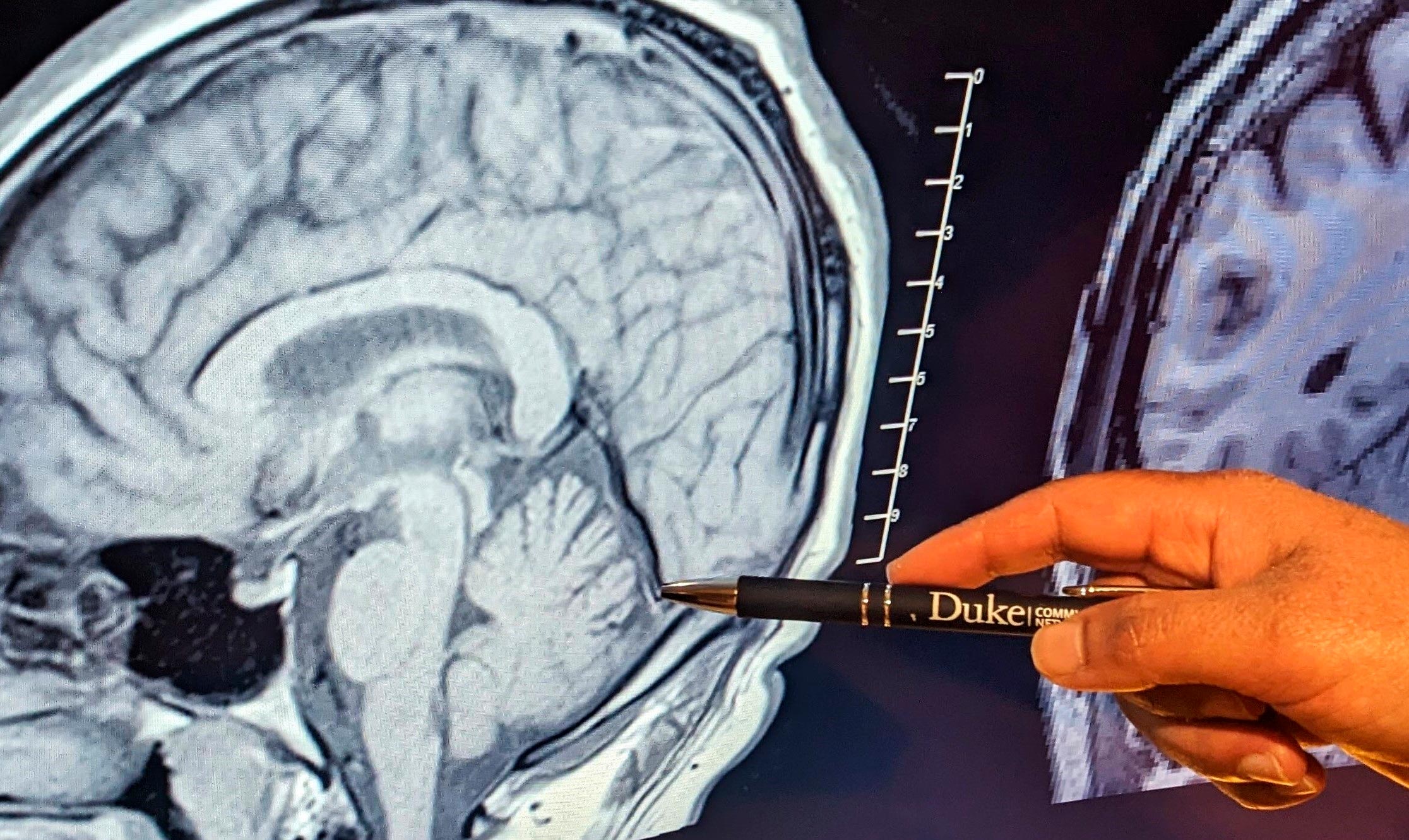
People with PTSD have a cerebellum about 2% smaller than unaffected adults, especially in areas that influence emotion and memory.
Adults with posttraumatic stress disorder (PTSD) have smaller cerebellums, according to new research from a Duke-led brain imaging study.
The cerebellum, a part of the brain well known for helping to coordinate movement and balance, can influence emotion and memory, which are impacted by PTSD. What isn’t known yet is whether a smaller cerebellum predisposes a person to PTSD or PTSD shrinks the brain region.
“The differences were largely within the posterior lobe, where a lot of the more cognitive functions attributed to the cerebellum seem to localize, as well as the vermis, which is linked to a lot of emotional processing functions,” said Ashley Huggins, Ph.D., the lead author of the report who helped carry out the work as a postdoctoral researcher at Duke in the lab of psychiatrist Raj Morey, M.D.
Huggins, now an assistant professor of psychology at the University of Arizona, hopes these results encourage others to consider the cerebellum as an important medical target for those with PTSD.
“If we know what areas are implicated, then we can start to focus interventions like brain stimulation on the cerebellum and potentially improve treatment outcomes,” Huggins said.
The findings, published on January 10 in the journal Molecular Psychiatry, have prompted Huggins and her lab to start looking for what comes first: a smaller cerebellum that might make people more susceptible to PTSD, or trauma-induced PTSD that leads to cerebellum shrinkage.
PTSD and the “Little Brain”
PTSD is a mental health disorder brought about by experiencing or witnessing a traumatic event, such as a car accident, sexual abuse, or military combat.
Though most people who endure a traumatic experience are spared from the disorder, about 6% of adults develop PTSD, which is often marked by increased fear and reliving the traumatizing event.
Researchers have found several brain regions involved in PTSD, including the almond-shaped amygdala that regulates fear, and the hippocampus, a critical hub for processing memories and routing them throughout the brain.
The cerebellum (Latin for “little brain”), by contrast, has received less attention for its role in PTSD.
A grapefruit-sized lump of cells that look like it was clumsily tacked underneath the back of the brain as an afterthought, the cerebellum is best known for its role in coordinating balance and choreographing complex movements, like walking or dancing. But there is much more to it than that.
“It’s a really complex area,” Huggins said. “If you look at how densely populated with neurons it is relative to the rest of the brain, it’s not that surprising that it does a lot more than balance and movement.”
Dense may be an understatement. The cerebellum makes up just 10% of the brain’s total volume but packs in more than half of the brain’s 86 billion nerve cells.
Researchers have recently observed changes to the size of the tightly-packed cerebellum in PTSD. Most of that research, however, is limited by either a small dataset (fewer than 100 participants), broad anatomical boundaries, or a sole focus on certain patient populations, such as veterans or sexual assault victims with PTSD.
Subtle and Consistent Reductions
To overcome those limitations, Duke’s Dr. Morey, along with over 40 other research groups that are part of a larger data-sharing initiative, pooled together their brain imaging scans to study PTSD as broadly and universally as possible.
The group ended up with images from 4,215 adult MRI scans, about a third of whom had been diagnosed with PTSD.
“I spent a lot of time looking at cerebellums,” Huggins said.
Even with automated software to analyze the thousands of brain scans, Huggins manually spot-checked every image to make sure the boundaries drawn around the cerebellum and its many subregions were accurate.
The result of this thorough methodology was a fairly simple and consistent finding: PTSD patients had cerebellums about 2% smaller.
When Huggins zoomed in to specific areas within the cerebellum that influence emotion and memory, she found similar cerebellar reductions in people with PTSD.
Huggins also discovered that the worse PTSD was for a person, the smaller their cerebellum was.
“Focusing purely on a yes-or-no categorical diagnosis doesn’t always give us the clearest picture,” Huggins said. “When we looked at PTSD severity, people who had more severe forms of the disorder had an even smaller cerebellar volume.”
Targeting the Cerebellum for Treatment and More Research
The results are an important first step in looking at how and where PTSD affects the brain.
There are more than 600,000 combinations of symptoms that can lead to a PTSD diagnosis, Huggins explained. Figuring out if different PTSD symptom combinations have different impacts on the brain will also be important to keep in mind.
For now, though, Huggins hopes this work helps others recognize the cerebellum as an important driver of complex behavior and processes beyond gait and balance, as well as a potential target for new and current treatments for people with PTSD.
“While there are good treatments that work for people with PTSD, we know they don’t work for everyone,” Huggins said. “If we can better understand what’s going on in the brain, then we can try to incorporate that information to come up with more effective treatments that are longer lasting and work for more people.”
Reference: “Smaller total and subregional cerebellar volumes in posttraumatic stress disorder: a mega-analysis by the ENIGMA-PGC PTSD workgroup” by Ashley A. Huggins, C. Lexi Baird, Melvin Briggs, Sarah Laskowitz, Ahmed Hussain, Samar Fouda, Courtney Haswell, Delin Sun, Lauren E. Salminen, Neda Jahanshad, Sophia I. Thomopoulos, Dick J. Veltman, Jessie L. Frijling, Miranda Olff, Mirjam van Zuiden, Saskia B. J. Koch, Laura Nawjin, Li Wang, Ye Zhu, Gen Li, Dan J. Stein, Jonathan Ipser, Soraya Seedat, Stefan du Plessis, Leigh L. van den Heuvel, Benjamin Suarez-Jimenez, Xi Zhu, Yoojean Kim, Xiaofu He, Sigal Zilcha-Mano, Amit Lazarov, Yuval Neria, Jennifer S. Stevens, Kerry J. Ressler, Tanja Jovanovic, Sanne J. H. van Rooij, Negar Fani, Anna R. Hudson, Sven C. Mueller, Anika Sierk, Antje Manthey, Henrik Walter, Judith K. Daniels, Christian Schmahl, Julia I. Herzog, Pavel Říha, Ivan Rektor, Lauren A. M. Lebois, Milissa L. Kaufman, Elizabeth A. Olson, Justin T. Baker, Isabelle M. Rosso, Anthony P. King, Isreal Liberzon, Mike Angstadt, Nicholas D. Davenport, Scott R. Sponheim, Seth G. Disner, Thomas Straube, David Hofmann, Rongfeng Qi, Guang Ming Lu, Lee A. Baugh, Gina L. Forster, Raluca M. Simons, Jeffrey S. Simons, Vincent A. Magnotta, Kelene A. Fercho, Adi Maron-Katz, Amit Etkin, Andrew S. Cotton, Erin N. O’Leary, Hong Xie, Xin Wang, Yann Quidé, Wissam El-Hage, Shmuel Lissek, Hannah Berg, Steven Bruce, Josh Cisler, Marisa Ross, Ryan J. Herringa, Daniel W. Grupe, Jack B. Nitschke, Richard J. Davidson, Christine L. Larson, Terri A. deRoon-Cassini, Carissa W. Tomas, Jacklynn M. Fitzgerald, Jennifer Urbano Blackford, Bunmi O. Olatunji, William S. Kremen, Michael J. Lyons, Carol E. Franz, Evan M. Gordon, Geoffrey May, Steven M. Nelson, Chadi G. Abdallah, Ifat Levy, Ilan Harpaz-Rotem, John H. Krystal, Emily L. Dennis, David F. Tate, David X. Cifu, William C. Walker, Elizabeth A. Wilde, Ian H. Harding, Rebecca Kerestes, Paul M. Thompson and Rajendra Morey, 10 January 2024, Molecular Psychiatry.
DOI: 10.1038/s41380-023-02352-0
Never miss a breakthrough: Join the SciTechDaily newsletter.
Follow us on Google and Google News.